
A little help choosing
Dishwasher buying guide.
Find the right fit for your kitchen and the way you live.
Replacing an old dishwasher or planning a new kitchen? Start with the space, then compare the features you will use. Here is what to check, with practical help from Hardy’s of Kilkeel.
Shop dishwashers →
01 / Start with the kitchen
Freestanding or integrated?
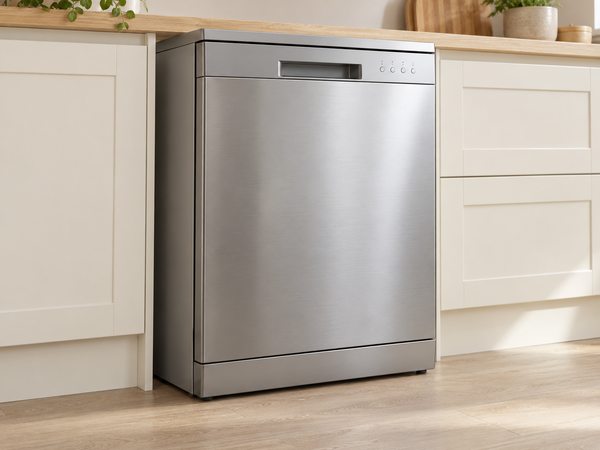
Freestanding
Has its own finished front and controls. It can suit an existing appliance space without a matching furniture door. Check the model’s installation instructions before planning to place it under a worktop.
Shop freestanding dishwashers →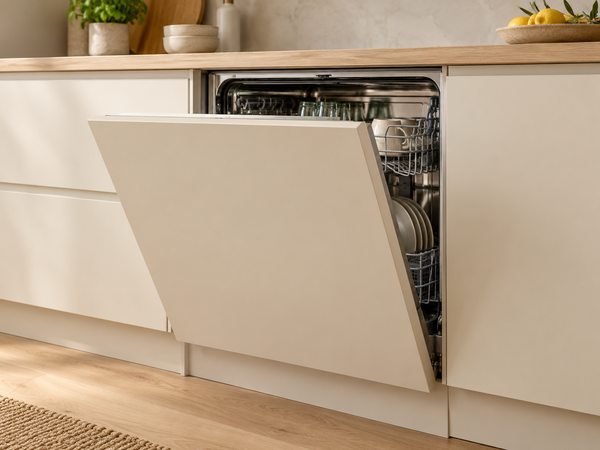
Fully integrated
Sits behind a matching cabinet door, with controls concealed when closed. The furniture door, hinge system and plinth clearance must suit the appliance. A similar width alone does not guarantee a straightforward replacement.
Shop integrated dishwashers →Replacing an integrated model?
Bring the old model number, a photograph of the opening and measurements of the cabinet door. We can help you compare the fitting information before you choose.
Semi-integrated models leave their control panel visible. If that is what you have, check the replacement arrangement carefully.
“Built-in” can describe different fitted arrangements. Check the individual model rather than relying on the name alone.
02 / Get the measurements right
Measure the space, then check the model.
Full-size or slimline?
Full-size dishwashers are commonly described as 60cm wide; slimline models as 45cm. These are size categories, not exact fitting dimensions. Height, depth and required clearances vary.
A slimline model may suit a narrower opening, but compare the usable basket space as well. Slimline describes width; it does not tell you whether the dishwasher is freestanding or integrated.
Your measuring checklist
- Measure the opening’s width, height and depth, including the narrowest points.
- Check space for hoses, connections and the open door.
- For integrated models, check furniture-door dimensions, hinge compatibility and plinth clearance.
- Check the delivery route, doorways, steps and any tight turns.
Use the chosen model’s installation drawing to confirm the fit. If you are unsure, send us measurements and photographs before ordering.
03 / Think about your everyday load
Look beyond the place-setting number.
Place settings provide a standard capacity comparison. Your own mix of pans, mugs, plates and lunchboxes may load differently. Think about a typical day, including the larger items you wash regularly.
Basket flexibility
Adjustable upper baskets and folding supports can help accommodate different loads. Check how easily they move and whether your tallest glasses and largest plates will fit together.
Drawer or basket?
A cutlery drawer separates items across the top; a basket groups them in a removable holder. Look at how each arrangement affects loading space and choose the one you find easier to use.
Daily routine
Consider how often you will run a full load. More capacity is useful only if it suits your household and the space available.
04 / Compare the label
Energy, water and noise—made clearer.
| What to compare | What it tells you |
|---|---|
| Energy rating | The A–G scale compares efficiency, with A the most efficient class. Compare models of a suitable size and capacity. |
| kWh per 100 cycles | Electricity consumption based on the Eco programme. Divide by 100 for the labelled consumption per cycle. |
| Water per cycle | Litres used by the Eco programme. Other programmes and options may use different amounts. |
| Programme duration | The length of the Eco cycle. A longer cycle does not automatically mean greater energy use. |
| Noise in dB | A lower declared figure indicates quieter operation under the test conditions. This can matter in an open-plan room. |
To estimate electricity cost per Eco cycle: labelled kWh per 100 cycles ÷ 100 × your electricity unit price. Actual costs depend on your programme, use and tariff; water charges, where applicable, are additional.
05 / Choose features with a purpose
What will make a difference to you?
Programmes
Look for settings that match your loads. Eco, automatic, intensive and quick programmes serve different purposes. Check the recommended load, duration and drying included in any quick cycle.
Drying
Drying systems vary. Plastics can be harder to dry because they retain less heat than crockery. If lunchboxes feature heavily in your washing-up, compare the drying system and options carefully.
Useful extras
Consider time displays, interior layout and controls you can read comfortably. Smart features may be useful, but check which functions need an app, an account or a compatible connection.
Compare the feature itself, not just the brand’s name for it. Ask what it does, when you would use it and whether it justifies the difference in price.
06 / Before you order
A few practical details worth checking.
Delivery and fitting
Tell us your postcode, access details and whether you are replacing a fitted appliance. Ask us to confirm the delivery, installation and old-appliance recycling options available for your order, including any charges and preparation needed.
Check that the existing water, drainage and electrical arrangements meet the new appliance’s requirements. Follow the manufacturer’s fitting instructions.
Guarantee and care
Check the guarantee shown for the exact model, including any registration deadline and terms. Keep your proof of purchase and model details.
Follow the manual for filter cleaning, dishwasher salt, rinse aid and suitable cleaning products. Care requirements depend on the machine, your detergent and local water conditions.
Browse accessories & care →A few common questions
Still weighing up the options?
Will my existing kitchen door fit a new integrated dishwasher?
Possibly, but do not assume it will. Check the new model’s door dimensions, weight limits, hinge system and plinth requirements against your existing kitchen. Bring photographs and the old model number if you need help.
Does a quick wash use less electricity?
Not necessarily. A shorter cycle may use a different temperature or washing pattern. Compare the manufacturer’s programme information. Eco is the reference programme used for the energy label.
Is a cutlery drawer better than a basket?
It depends on how you load. Compare access, the space left for other items and how easily you can arrange your everyday cutlery. If possible, try the layout before choosing.
Will all my plastic containers come out dry?
Results vary with the material, loading, programme and drying system. Plastics retain less heat, so they can stay wetter. Check that items are dishwasher-safe and follow the appliance’s loading and rinse-aid guidance.
Can Hardy’s help me choose?
Yes. Bring your measurements, photographs and a shortlist, or tell us what you like and dislike about your current dishwasher. We can help you compare the options and practical details.
Here to help in Kilkeel
Bring the measurements.
We’ll help with the choice.
Talk to the Hardy’s team about your space, routine and budget.
Ask our team →